

Debt burdens are elevated, and income growth is not keeping pace with rising costs.
Image: ChatGPT
South Africans earning more than R50,000 per month are now spending more than their entire salaries servicing debt, despite months of interest rate relief and withdrawals from the two-pot retirement system helping consumers to stay afloat.
The latest DebtBusters Debt Index for the first quarter of 2026 found that consumers in the highest income bracket now require 101% of their take-home pay to service debt every month, while their debt-to-income ratio has climbed to 303% - the highest of any income group.
DebtBusters executive head Benay Sager told IOL that people in this income group are actually not paying their debt so they can afford items such as food and water. He explains that the 101% is what the amount would work out to if they were paying what they owe, and this is why they are seeking help through debt counselling.
Sager also said successive interest rate cuts and access to retirement savings through the two-pot system had provided temporary financial relief to many households.
However, Sager warned that global inflationary pressures and the growing possibility of future interest rate hikes were once again increasing financial stress for consumers.
The report also highlights the growing squeeze from living costs.
Since 2021, electricity tariffs have risen by 85%, petrol prices by 36%, and inflation by 27%, while average take-home pay for incoming debt counselling clients increased by only 25%.
“What remains consistent is that debt burdens are elevated, and income growth is not keeping pace with rising costs,” he said.

DebtBusters executive head Benay Sager.
Image: Supplied
The findings come just days before the South African Reserve Bank’s Monetary Policy Committee is set to announce its latest interest rate decision.
Economists are increasingly warning that higher oil prices and inflationary pressure linked to Middle East tensions could complicate the outlook for further rate cuts.
Most economists and market watchers expect a 25-basis-point hike, which would take the prime lending rate to 10.50%.
DebtBusters noted that the average interest rate for vehicle finance is at 13.6% a year and home loans comes in at 10.2%, while unsecured credit – such as credit cards – is at 17.9%.
According to DebtBusters, consumers who applied for debt counselling during the quarter needed 64% of their take-home pay to service debt overall, down from the 73% peak recorded in the first quarter of 2021, “but still deeply elevated,” said Sager.
The report found South Africans are increasingly relying on unsecured lending to survive. A record 96% of debt counselling applicants now have a personal loan, while 61% have a one-month or payday loan.
The average number of credit agreements per applicant has climbed to 8.5 per person, the highest level since 2017, suggesting growing dependence on multiple lenders.
DebtBusters found that unsecured debt levels are now 23% higher than in 2021 on average. For consumers earning more than R50,000 a month, unsecured debt has surged by 99% since 2021, far outpacing inflation and salary growth.
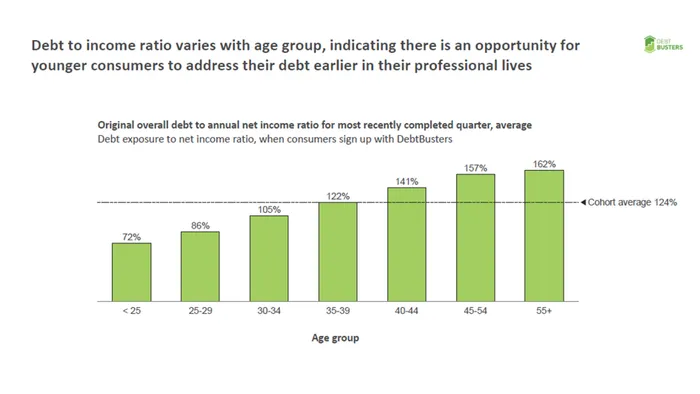
Those aged 55 and older have the highest debt-to-income ratio.
Image: Supplied
While top earners have seen debt levels explode, lower-income consumers have experienced a different form of pressure.
DebtBusters said total debt levels for lower-income groups had fallen by as much as a quarter, but largely because consumers were losing access to credit rather than becoming financially healthier.
For consumers earning between R10,000 and R20,000 a month, described by DebtBusters as the backbone of South Africa’s working population, almost a third of disposable income now goes towards food alone.
The report also found that financial distress is increasingly affecting younger consumers earlier in life, with people born after 2000 now accounting for 9% of new debt counselling applicants.
IOL BUSINESS