

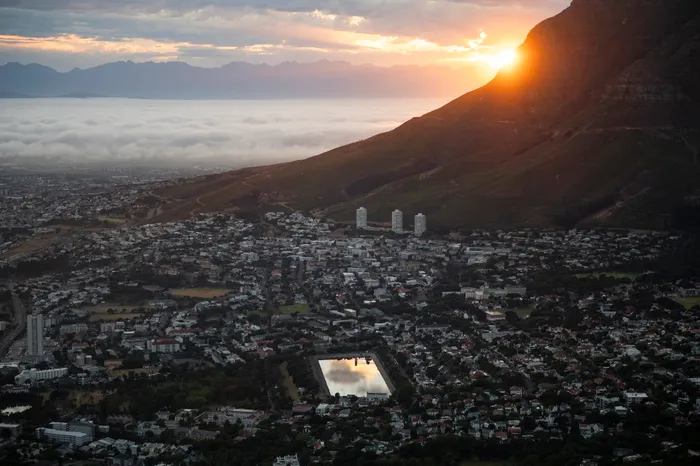
Globally, cities are shifting toward more sustainable transport solutions, and Cape Town will eventually need to accelerate in the same direction.
Image: Armand Hough
Population growth, urban expansion, tourism, commercial investment and residential development are reshaping the Cape Town at an unprecedented pace.
From the Northern Corridor developments to growing economic activity around the CBD, Century City, Bellville and the West Coast, infrastructure is becoming one of the most important conversations for the city’s future, says
“Anyone commuting during peak hours understands the strain currently placed on Cape Town’s transport network,' said Edrich Kleynhans, a planning consultant and construction manager.
"Congestion along the N1, N2, R300, Voortrekker Road and key arterial routes continues to impact productivity, logistics and overall quality of life. As the city expands outward, the need for smarter and more integrated transport infrastructure becomes increasingly urgent.”
The construction manager says road infrastructure is often viewed simply as construction projects, resurfacing works or highway upgrades. In reality, infrastructure is one of the largest drivers of economic development, he says.
Efficient transport systems:
•Improve access to employment opportunities
•Reduce travel times and fuel costs
•Support logistics and freight movement
•Attract investment into new development zones
•Increase property and commercial growth potential
•Improve connectivity between communities
“Cape Town’s long-term economic competitiveness will depend heavily on how effectively it manages urban mobility and transport accessibility over the next decade.”
One of the most important infrastructure developments in Cape Town over the past decade has been the expansion of the MyCiTi bus service, says Kleynhans.
He says while public opinion around transport systems can often be divided, the reality is that integrated public transport is essential for any growing city. Cape Town cannot rely solely on private vehicle usage if it wants to remain economically efficient and environmentally sustainable, he adds.
“The MyCiTi system represents more than buses - it represents the beginning of a smarter urban mobility framework.”
He says the expansion of MyCiTi routes has the potential to:
•Reduce congestion on major transport corridors
•Improve accessibility between residential and economic hubs
•Support lower-income communities with safer transport options
•Encourage transit-oriented development
•Reduce long-term carbon emissions
•Improve urban planning efficiency
He adds that future phases and route expansions could play a major role in connecting high-growth areas across the metro, particularly as development continues along the northern and eastern corridors.
Cape Town’s urban footprint continues to expand rapidly toward areas such as:
•Durbanville
•Paarl corridor connections
•Somerset West
•Milnerton and the West Coast
•Airport Industria
•Bellville and northern suburbs
These areas are experiencing increasing residential and commercial demand, placing additional pressure on existing road infrastructure, says Kleynhans.
He says without strategic upgrades and long-term transport planning, congestion and inefficiency could become major limitations to economic growth.
Infrastructure investment must therefore focus not only on expanding roads, but also on:
•Smart traffic management systems
•Integrated public transport
•Sustainable urban planning
•Freight mobility optimisation
•Road maintenance and rehabilitation
•Pedestrian and cycling accessibility
Globally, cities are shifting toward more sustainable transport solutions, and Cape Town will eventually need to accelerate in the same direction, says the construction manager.
He says future infrastructure planning will increasingly involve:
•Electrified public transport systems
•Intelligent traffic monitoring
•Data-driven transport planning
•Reduced car dependency
•Climate-resilient infrastructure design
•Mixed-use urban development
As fuel costs rise and urban density increases, cities that invest early in efficient public transport and integrated infrastructure systems will be better positioned for long-term growth.
Civil engineering and infrastructure development
Civil engineering and infrastructure development will play a defining role in shaping Cape Town over the next 20 years, says Kleynhans.
He says the challenge is no longer simply building roads-it is designing infrastructure systems that can support economic growth, social mobility, sustainability, and future urban expansion simultaneously.
Potential for continued growth and investment.
“Cape Town has enormous potential for continued growth and investment. However, unlocking that potential will depend on forward-thinking infrastructure planning, strong public-private collaboration, and continued investment in transport systems like MyCiTi.”
He adds that the future of Cape Town will not only be determined by the buildings it constructs, but by how effectively they connect people, communities, and opportunities.
In April, Grant Elliott, the deputy chairperson of the Central City Improvement District (CCID) board and COO of property development company Thibault Investments owned by the Heriot REIT, said Cape Town’s broader residential market is still showing strong price growth compared with other South African cities.
They said persistent investor confidence and strong demand for residential and commercial offerings is boosting the property outlook in Cape Town’s city centre.
As 2026 unfolds, they said the bulk of property investment into the Cape Town CBD continues to be in residential and mixed-use developments.
Cape Town CBD residential units remain popular with buyers viewing the inner city as a vibrant, mid- to long-term investment. This is reflected in the increase in the number of residential units in the CBD, which has grown to over 7 000 units, they said.