

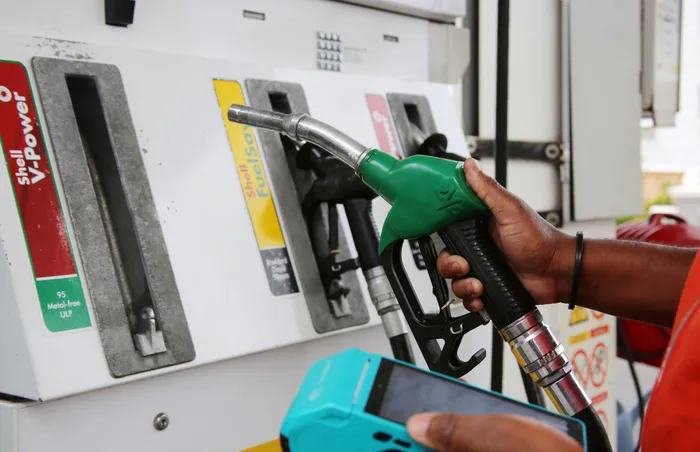
South African consumers brace for a financial storm in May as fuel prices surge, with petrol rising by R3.27 and diesel by R6.19. Discover the factors behind these increases and their implications for households.
Image: Tumi Pakkies / Independent Newspapers
South African consumers will face a financial storm in May after the Department of Mineral and Petroleum Resources (DMPR) announced fuel price increases for the month on Monday.
Both grades of petrol will increase by R3.27 per litre, while diesel will go up by R6.19.
The DMPR said that South Africa’s fuel prices are adjusted monthly, informed by international and local factors.
International factors include the fact that South Africa imports both crude oil and finished products at a price set at the international level, including importation costs.
The effects of the geopolitical tensions, more specifically, the ongoing conflict between the United States and iran, and the closure of the strategic oil shipping Strait of Hormuz, has taken its toll on international oil prices.
The average Brent Crude oil price increased from $93.67 to $101 a barrel during the period under review for local fuel prices.
The DMPR stated, "The average international product prices followed the increasing trend of crude oil prices. The prices of middle distillates (diesel and paraffin) increased more than petrol pricesbecause of higher demand and reduced supply from the Persian Gulf. These factors led to higher contributions to the Basic Fuel Prices of petrol,diesel and illuminating paraffin by R2.04 per litre, R4,96 per litre and R4,21 per litre, respectively. The pricesof Propane and Butane increased during the period under review due to limited global supply since the closure of the Strait of Hormuz."
The increases translate to South Africans paying R25.80 for a litre of 95 Unleaded petrol at the coast and R26.33 inland, where 93 Unleaded will cost in the region of R26.52, from Wednesday this week.
The wholesale price of 50ppm diesel will rise to about R31.54 at the coast and R32.30 in Gauteng, with the retail margin adding a further R2.50 to R3, depending on the outlet.
This will be a new record-high price for diesel.
The Petrol price, however, remains slightly below the peak price reached in July 2022 of R26.09 per litre at the coast.
Based on current local and international factors, the fuel prices for May 2026 will be adjusted as follows:
National Treasury and the Department of Mineral and Petroleum Resources announced last week that the R3 fuel tax relief would remain in place for petrol during May, while diesel would see a further 93c reprieve for the month.
However, from July onwards, motorists will pay the full General Fuel Levy amounts of R4.10 on petrol and R3.93 for diesel.
June could possibly lead to even higher fuel price shocks, should there not be a resolution to the war in the Middle East.
Following government's announcement of the extended fuel relief, trade unions sounded the alarm over rising fuel costs, warning that government’s extended levy relief will not be enough to shield workers and the economy from the price shocks driven by global oil market turmoil.
The Motor Industry Staff Association (MISA) described the current measures as inadequate in the face of mounting pressures linked to the Middle East conflict, which has driven global oil prices sharply higher.
“This is not just about numbers at the pump – it is about survival. Families are being crushed between fuel, electricity, and food costs. Government’s minimal relief is a band aid on a deep wound,” said Martlé Keyter, MISA’s CEO for operations.
Debt Rescue CEO, Neil Roets said that another fuel price increase in May should be treated as a red alert for South Africa.
"Asking consumers to once again “brace” for impact issimply not realistic. Most households have already run out of room to adjust their budgets.They are hanging on by a very thin thread," Roets said.
He added that the real concern lies in the broader economic impact.
"Fuel price increases, particularly in diesel, drive up the cost of transporting goods, which in turn pushes up food prices and essential household expenses. Consumers are hit on multiple fronts, and this will inevitablyplace upward pressure on inflation. The knock-on effects are deeply concerning. For millions of South Africans, the cost ofcommuting, whether by private vehicle or public transport, is becoming unaffordable. Travel to and from work is becoming increasingly financially unviable, especially for lower-incomehouseholds," Roets said.
The Debt Rescue CEO further said that that more needs to be done to cushion households from yet another fuel price shock.
Follow Business Report on Facebook, X and on LinkedIn for the latest Business and tech news.