

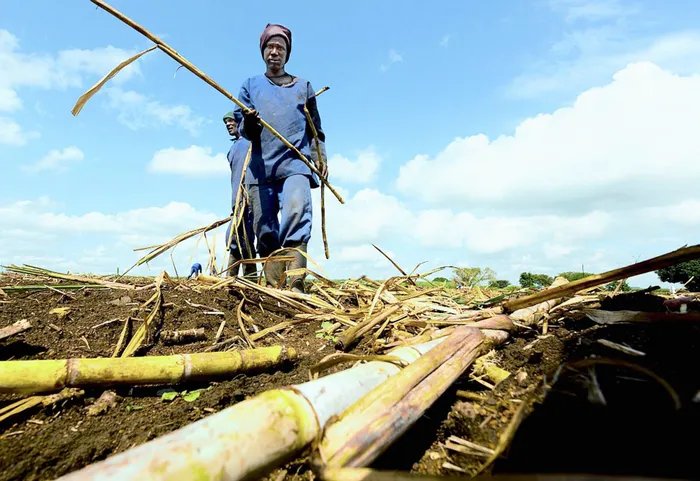
GrowerCo said its proposal was designed around the long-term sustainability of Tongaat Hulett and included both small- and large-scale sugarcane growers as equity partners.
Image: Supplied
A new grower-led rescue initiative has emerged to try save embattled sugar producer Tongaat Hulett from liquidation, with industry stakeholders warning that the collapse of the company could devastate KwaZulu-Natal’s rural economy and thousands of livelihoods linked to the sugar industry.
With Tongaat Hulett’s liquidation hearing less than a month away, a newly established entity called GrowerCo on Thursday said it was seeking to secure funding to keep the company’s mills and refinery operational while positioning growers themselves at the centre of ownership and decision-making.
The initiative has the backing of both SA Canegrowers and the South African Farmers’ Development Association (SAFDA), and is being presented as an alternative to private-equity-led restructuring proposals.
GrowerCo said its proposal was designed around the long-term sustainability of Tongaat Hulett and included both small- and large-scale sugarcane growers as equity partners.
The move comes as pressure mounts on South Africa’s sugar sector, which is already battling cheap sugar imports, rising production costs and uncertainty over the future of key milling infrastructure.
According to GrowerCo, more than 17,500 of South Africa’s 28,000 sugarcane growers supply Tongaat Hulett mills, with the majority being small-scale farmers. The company also plays a central role in KwaZulu-Natal’s economy, where approximately 77% of the sugar industry’s revenue is generated.
Pratish Sharma, a grower who supplies Tongaat Hulett’s Maidstone Mill, warned that the consequences of liquidation would extend far beyond the company itself.
“The long-term economic and societal consequences of its liquidation would far exceed the liabilities on the company’s balance sheet,” Sharma said.
He added that GrowerCo’s model aimed to preserve Tongaat Hulett’s South African sugar operations as a going concern while ensuring broader participation in ownership.
“It has been designed by the people who supply the cane, operate the mills, and depend on the industry, and is built around patient capital and a model of reinvestment. GrowerCo would also be a beacon of real transformation in South Africa by including small-scale growers at ownership level.”
Nicholas Ngobe, a grower supplying the Amatikulu Mill, said the proposal also represented an opportunity for meaningful economic transformation in the sector.
“It is also a beacon of what true economic transformation can be. Small-scale growers are equity partners in GrowerCo and will earn returns not only on their sugarcane but will share in equity growth over the long run,” he said.
“This creates the possibility that a sugarcane grower who today owns and farms their own land, but whose forebears may once have worked as indentured labourers in the province’s sugar fields, could become an owner in one of South Africa’s oldest sugar companies.”
Agricultural economists and industry experts have also welcomed the initiative, saying Tongaat Hulett’s survival is critical to maintaining stability across the broader agricultural value chain.
Dranca Neo Phalatse, postgraduate coordinator at the faculty of natural and agricultural sciences at the University of Pretoria, said the proposal appeared to offer a more sustainable and inclusive path forward.
“What makes the proposal particularly noteworthy is its stakeholder-inclusive approach, where both small- and large-scale growers are positioned not only as suppliers but also as equity partners,” she said.
“This creates stronger alignment between those directly dependent on the industry and the long-term success of the company.”
Phalatse warned that liquidation could have severe ripple effects across rural communities, employment and agricultural production in KwaZulu-Natal.
Dr Thomas Funke, CEO of SA Canegrowers, said the emergence of GrowerCo reflected the determination of farmers to protect jobs, communities and critical agricultural infrastructure.
“At a time when the industry faces significant uncertainty – from the threat of Tongaat Hulett’s liquidation to increasing pressure from sugar imports undermining local growers – this initiative demonstrates the resilience, determination and long-term vision of South African sugarcane growers,” Funke said.
“Growers are stepping forward with solutions to protect jobs, sustain rural communities and preserve critical agricultural infrastructure. Growers are fighting for rural South Africa, for the communities built around sugar production.”
Dawee Maree, head of agriculture information and marketing at FNB, said Tongaat Hulett remained an important pillar of South Africa’s agricultural economy.
“Companies like Tongaat are important for the agricultural industry and definitely for small growers and family farmers. Tongaat is a major player in the sugar industry, which in turn is an important industry in KZN’s economy,” Maree said.
BUSINESS REPORT