

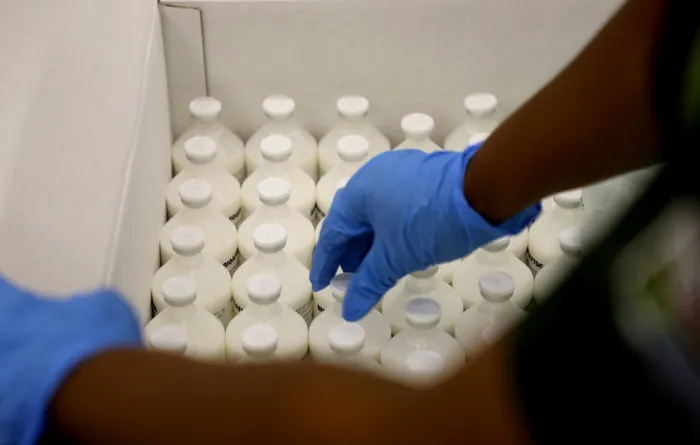
Applicants that approached the Gauteng High Court including Sakeliga and Free State Agriculture have welcomed Monday’s ruling that will allow farmers, under guidelines, to privately procure Foot and Mouth Disease (FMD) vaccines and administer them to their livestock.
Image: Timothy Bernard / Independent Newspapers
Applicants that approached the Gauteng High Court including Sakeliga and Free State Agriculture (FSA) have welcomed Monday’s ruling that will allow farmers, under guidelines, to privately procure Foot-and-Mouth Disease (FMD) vaccines and administer them to their livestock.
Sakeliga spokesperson Anton Meijer on Tuesday said that the Pretoria High Court has granted an order that FMD vaccines may be procured and administered privately, without state veterinary involvement.
“The Minister of Agriculture was also interdicted from interfering in private commercial relations of those who lawfully import FMD vaccines into South Africa.”
Meijer added that the order, in favour of Sakleiga, Southern African Agri Initiative (Saai), and FSA, confirms that owners and managers of cloven-hooved livestock may independently procure and administer lawfully obtained FMD vaccines.
“The court found that the Minister of Agriculture John Steenhuisen, his Director-General, and the Director of Animal Health had "vehemently opposed" the application, yet “failed to indicate any substantive defence,” “engineered delays in having the matter heard and adjudicated upon”, and that their conduct “calls for some sanction from the court.”
Meijer said that the court described Steenhuisen's section 10 scheme as “vexed,” finding that it did not provide for any controlled purpose or for the improvement of animal health.
“Farmers, feedlots, dairy operations, and related agri-businesses now have a court-protected route to procure approved FMD vaccines from lawful importers, manufacturers, or their agents. “No participation in the state’s section 10 scheme is required,” he said.
“They may also administer those vaccines to their livestock under the notification and reporting conditions set out in the order (e.g., at least 5 days' prior written notice to the Provincial Director before vaccination, and notice within 14 days after vaccination).”
Meijer said that the judgment vindicated what the applicants have argued from the outset: that there is no lawful impediment to livestock owners and managers obtaining approved FMD vaccines and administering those to their animals.
The FSA also welcomed the court decision.
“This development directly addresses the long-standing position advanced by FSA, namely that there is no lawful basis to prevent responsible private-sector participation in vaccination efforts,” it said.
“The order further prohibits undue interference by the state in lawful commercial relationships within the vaccine supply chain, reinforcing the need for a functional and accessible vaccine market.”
FSA added that the court has also ordered Steenhuisen, the department's director-general, and the director of animal health to bear the legal costs of the application.
“This ruling builds on earlier court interventions where the government was compelled to act with urgency and transparency in addressing the FMD crisis.”
Francois Wilken, president of FSA, said that this order was a major step forward for farmers who have been left exposed for too long.
“It confirms that producers can take responsible action to protect their herds, while government delays and interference are no longer acceptable. While the order provides immediate interim relief, the matter will proceed to final determination, with further legal steps to be instituted within 20 days.”
Meanwhile, Steenhuisen said the practical effect of the matter is now largely overtaken by the gazetted Section 10 animal health scheme, which already provides a lawful framework for participation by private industry role players in the national vaccination effort.
Steenhuisen added that the government has consistently supported a coordinated public-private approach to combating FMD.
“Millions of vaccines have already been allocated to organised industry structures, including the Milk Producers’ Organisation (MPO), while further allocations are being rolled out to feedlots, stud breeders, and commercial farmers,” he said.
Steenhuisen said his primary focus remains the implementation of the national FMD Strategy through the Ministerial Task Team and the Industry Coordinating Committee on FMD.
“Our objective remains to vaccinate at least 80% of the national cattle population with two doses of vaccine as swiftly as possible as part of South Africa’s pathway toward achieving WOAH-recognised FMD free with vaccination status. This would unlock significant export opportunities for South Africa’s red meat sector.”
BUSINESS REPORT