

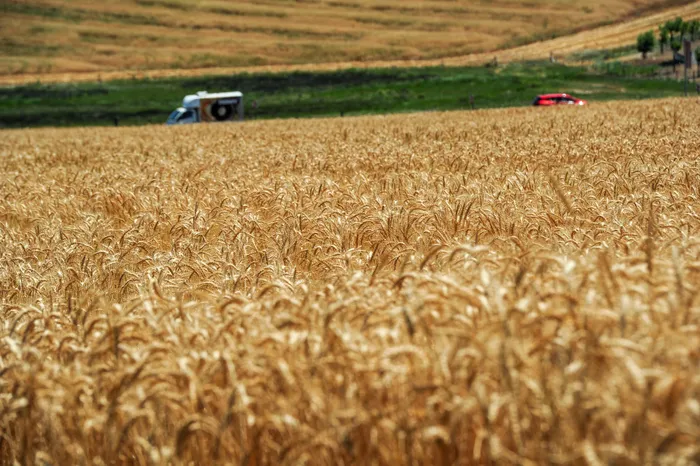
Grain SA confirmed on Wednesday that they would start the process of legal action against the Department of Trade Industry and Competition (DTIC) following continued delays in the implementation of the revised wheat tariff.
Image: Henk Kruger Independent Newspapers
Grain SA has confirmed that it is proceeding with legal and administrative action against the Department of Trade, Industry and Competition (the dtic) after what it describes as prolonged and unacceptable delays in the implementation of a revised wheat tariff designed to protect local producers.
The move follows years of uncertainty surrounding a tariff application submitted to the International Trade Administration Commission of South Africa (ITAC) in June 2024.
Grain SA on Wednesday argued that South African wheat farmers continue to face growing pressure from subsidised imports from major wheat-producing countries while waiting for government authorities to finalise the application.
In a joint effort with the South African Cereals and Oilseeds Trade Association (Sacota), Grain SA last week sent a formal request to the dtic and ITAC seeking a final status report on the implementation of the revised tariff.
The organisations had previously issued a formal letter of demand on 22 May, giving ITAC, the dtic minister, and the Minister of Finance until 1 June to provide clarity on the matter.
According to Grain SA, that deadline has now passed without any meaningful response from the government and the industry is still awaiting finality two years later.
“For months, the organisations have repeatedly followed up with ITAC to obtain even basic information on the progress of the application, but the industry has received no meaningful response.”
Richard Krige, Chairperson of Grain SA, said the continued delays were placing significant strain on producers who are already operating in a highly competitive and volatile market environment.
“Policy delays in volatile markets have real economic consequences for food security and rural employment.”
On Wednesday, Dr Dirk Strydom, managing director for Nampo, confirmed that the organisation had begun implementing legal and administrative measures to secure a final decision on the tariff application.
“In accordance with the mandate given to us by producers, Grain SA is currently implementing the following legal and administrative steps to obtain finality regarding the revised wheat tariff application,” Strydom said.
He added that the continued delay in finalising this matter remains a source of serious concern for the wheat industry, particularly at a time when producers are already operating under increasing cost and market pressures.
Dr André van der Vyver, an executive director Sacota, said the association was also evaluating its next steps.
He explained that the joint application submitted nearly two years ago comprised two key components: a revision of the dollar-based reference price and a new methodology for implementing tariff adjustments.
“Our members, who are continuously importing wheat, have a particular interest in the latter. We asked for a monthly implementation methodology, similar to the fuel price system,” he said.
He argued that the current system is inefficient and often results in delays that undermine the intended protective effect of tariffs when they are most needed.
“The well-being of the total industry, from production to consumer, is critical to all role players in the value chain. It is the only way to ensure economic growth and food security. The purpose of our joint letter addressed to Minister Tau was to emphasise the necessity to resolve the matter.”
Van der Vyver noted that the process involves multiple institutions, including ITAC, the dtic and the National Treasury. Even after approval by the dtic minister Parks Tau, the application would still need to be considered by Treasury before implementation.
“As of yesterday, we had no further response. These delays are unacceptable. Should we not receive a timely response, I believe the two applicants, Grain SA and Sacota, will independently consider their options going forward,” he said.
The dtic was contacted for comment on Wednesday and said that they would respond accordingly.
Meanwhile, agricultural economists warn that the wheat sector is facing mounting challenges.
Wandile Sihlobo, chief economist at Agricultural Business Chamber of South Africa (Agbiz), said global wheat supplies remain abundant, placing downward pressure on international and domestic wheat prices.
He added that farmers are now contending with rising input costs, including fertiliser and fuel, partly driven by geopolitical tensions and conflict in the Middle East.
“The challenge at the moment, as we start the 2026-27 season, is not only lower wheat prices but also a surge in input costs, including fertiliser and fuel, due to the war in the Middle East,” he said.
“The industry is in a position where wheat prices are under pressure from ample global supplies, but the start of the season is challenging due to rising input costs.”
BUSINESS REPORT