

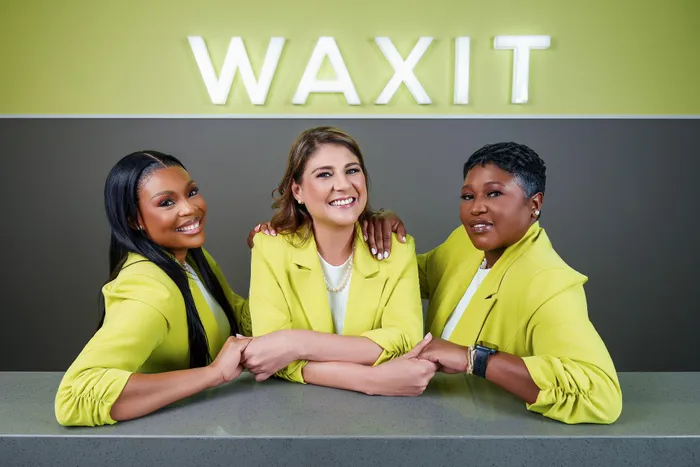
Long serving WAXIT employees Thuli Ngwenya and Precious Matabane with WAXIT founder Michelle Royston. Ngwenya and Matabane are now co owners of the brand’s first micro franchise store in Johannesburg.
Image: Supplied.
For years, Thuli Ngwenya and Precious Matabane helped build the WAXIT brand from inside the business.
Today, they are helping shape its future as co owners of the company’s first micro franchise store at Mall of the South in Johannesburg.
The launch marked more than a new store opening. It represented a new pathway to business ownership for South African women, designed to help employees move from staff members to entrepreneurs through structured support, mentorship and training.
For Ngwenya and Matabane, the moment is the result of years of commitment, growth and determination.
Ngwenya joined WAXIT 11 years ago as a WAXITologist and steadily rose through the business to lead the brand’s accredited training centre.
In that role, she became responsible for developing new talent and helping maintain service standards across the growing business.
“This journey means everything to me because I started on the floor and worked my way up,” said Ngwenya.
“To now be in a position of ownership shows that hard work and loyalty can open doors.”
Matabane’s path began at the front desk as a receptionist before she advanced into a national quality assurance role, helping oversee standards across WAXIT’s network of branches.
“I never imagined when I first joined as a receptionist that I would one day co own a store,” said Matabane.
“It is proof that growth is possible when a company believes in its people.”
WAXIT founder Michelle Royston said the micro franchise concept was created to give employees a realistic route into ownership in a country where access to capital remains one of the biggest barriers to entrepreneurship.
Through a five year incubation model, selected employees receive funding support, mentorship and operational training before taking full ownership.
“I want to build a legacy, not an empire,” said Royston. “Empires expand. Legacies endure.”
That philosophy is now being lived out through Ngwenya and Matabane, whose years of operational experience gave them a strong foundation to step into business leadership.
In South Africa, women own only a small share of formal businesses, despite increasing participation in entrepreneurship.
For Ngwenya and Matabane, their new roles carry significance beyond personal achievement.
“It is important for women to see that ownership is possible. We do not have to wait for opportunities. Sometimes we can grow into them,” said Ngwenya.
Matabane said the transition also sends a powerful message to workers who may feel limited by their starting positions.
“Many people think where you begin is where you stay,” she said.
“My story shows that your first role does not define your future.”
Founded in 2015, WAXIT has expanded to 41 branches across Gauteng, KwaZulu Natal and the Western Cape.
The new store at Mall of the South is the first test of what could become a broader ownership model within the company.
For Ngwenya and Matabane, the focus now is on making the store a success while inspiring others to follow.
“We want to build something that creates jobs, empowers women and makes people proud,” said Ngwenya.
Matabane added that the opportunity comes with both pride and responsibility.
“We know people are watching this journey,” she said. “We want to show that when women are trusted with ownership, they can thrive.”
As South Africa searches for new ways to unlock inclusive growth, the success of two women who rose through the ranks may offer one of the clearest examples yet of how businesses can create owners, not just employees.
Follow Business Report on Facebook, X and on LinkedIn for the latest Business and tech news.