

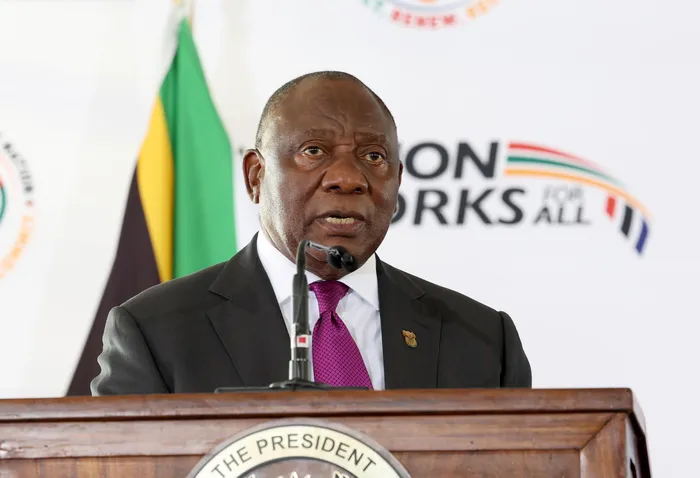
President Cyril Ramaphosa announces a landmark R1 trillion infrastructure investment programme at the South Africa Infrastructure Investment Summit, aiming to tackle unemployment and stimulate economic growth.
Image: Supplied
President Cyril Ramaphosa has announced a sweeping R1 trillion infrastructure investment programme aimed at accelerating economic recovery and confronting South Africa’s deepening unemployment crisis, as the government shifts focus toward turning fragile growth into real job creation.
Speaking at the South Africa Infrastructure Investment Summit in Cape Town on Wednesday, Ramaphosa acknowledged that despite recent signs of macroeconomic stability, the economy is still failing to generate sufficient employment.
“We have recorded four consecutive quarters of growth into early 2026, although we are yet to see this translate into a meaningful rise in employment,” Ramaphosa said, underscoring the disconnect between growth and job creation.
The President said the scale of unemployment demands urgent intervention through large-scale infrastructure development, positioning public investment as a key lever for labour absorption and economic revival.
Over the next three years, government will channel more than R1 trillion into infrastructure across national, provincial and state-owned entities, focusing on transport, energy, water systems and logistics corridors.
Ramaphosa said the programme is designed not only to rebuild ageing infrastructure but to stimulate industries capable of absorbing large numbers of workers.
“These commitments represent factories being built, renewable energy projects being connected to the grid, logistics corridors being modernised, jobs being created, and confidence being restored,” he said.
South Africa continues to grapple with one of the highest unemployment rates in the world, with young people bearing the brunt of joblessness, placing sustained pressure on government to convert policy reforms into tangible employment outcomes.
The infrastructure push forms part of a broader investment drive, with Ramaphosa also announcing a target of R3 trillion in private and public investment over the next five years to boost economic expansion.
He said the success of the strategy depends on closing the gap between investor confidence and actual capital deployment that translates into employment.
“Our objective is to translate reform momentum into greater investment, faster growth and more jobs,” he said.
A key pillar of the plan includes reforms in energy and logistics, particularly the restructuring of Eskom and expanded private participation in rail and port operations, aimed at removing bottlenecks that have constrained growth and job creation.
Ramaphosa said government is also targeting high-impact sectors such as manufacturing, agriculture, mining beneficiation and green industrialisation, which are expected to generate more labour-intensive opportunities.
Despite the optimistic outlook, he acknowledged ongoing challenges including infrastructure-related crime, corruption and construction site extortion, which continue to delay project delivery and discourage investment.
The President, however, insisted that South Africa is entering a new phase of reform-driven growth, urging investors to participate in rebuilding the economy.
“We are not merely building infrastructure. We are building a new growth path for South Africa,” he said, framing the R1 trillion programme as a decisive intervention to reverse unemployment and restore economic momentum.
IOL News