


Lonely older people are especially vulnerable to scams.
Image: ChatGPT
Elderly South Africans are especially vulnerable to high-impact financial and impersonation scams, particularly where loneliness, trust and retirement savings are involved.
Leslie Greyling, a financial advisor at Brenthurst Wealth Fourways, says older people are particularly vulnerable to scams and fraud, although those more used to technology tend to be more exposed because they use it more often.
Sharon Knowles, founder and chief executive of Da Vinci Forensics, says South Africa is facing a “quiet crisis” in which grandparents, retired neighbours and ageing parents are being targeted. Criminals do not simply exploit technical unfamiliarity but also loneliness, trust, financial anxiety and deeply ingrained social values, she says.
“Perhaps the most powerful tool in a cybercriminal’s arsenal is social isolation. Many South African seniors live alone, while children may have relocated to other provinces or emigrated abroad. Social circles often become smaller with age,” Knowles says.
A ringing phone or a WhatsApp message can represent an important moment of human interaction – a behavioural trait that criminals understand. “They are often patient, polite, and emotionally intelligent,” Knowles says.
Romance scams and “grandchild in distress” scams are so effective because they exploit emotional attachment, compassion and the instinct to protect loved ones, says Knowles. Studies consistently identify loneliness and social isolation as significant contributing factors to fraud victimisation of older people, she adds.
“Many elderly South Africans were raised in communities where personal reputation mattered, institutions were respected and trust formed the foundation of daily interactions,” says Knowles.
When callers claim to represent the South African Revenue Service, a bank or a government agency, many seniors instinctively respond with cooperation rather than suspicion, explains Knowles. Scammers deliberately exploit this respect for authority through threats involving frozen pensions, blocked bank accounts, unpaid taxes or South African Social Security Agency complications, she adds.
Knowles says research increasingly shows that older adults are deliberately targeted because fraudsters perceive them as “more trusting, financially stable, and socially isolated”.
A 2025 Springer Nature study found that older adults are especially vulnerable because of physical frailty, cognitive decline, social isolation, limited digital skills and low awareness of privacy and security risks. “Ageism stands out as one of the most profound challenges older adults face; stripping them of the self-respect afforded to others,” the authors write.
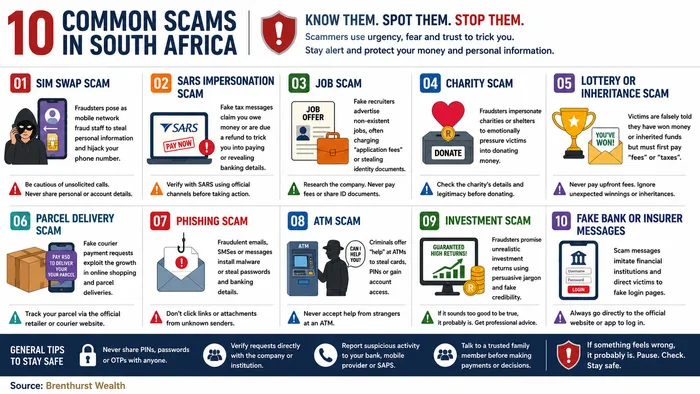
The most commons scams in South Africa.
Image: ChatGPT
The South African Banking Risk Information Centre’s latest Crime Statistics Report for 2024 shows financial crime continued to rise sharply, with an unprecedented 86% increase in digital banking fraud incidents and a 74% rise in related losses, reaching R1.888 billion. These figures reflect the broader population, not elderly victims alone.
In the 2024/25 financial year, the Financial Intelligence Centre contributed to the recovery of close to R144 million in criminal proceeds through more than 4 000 financial intelligence reports.
Its Shared Forensic Capability unit, created in May, contributed to asset recoveries of R14.37 million and the enrolment of 14 cases for prosecution in its first full year. Marise Smit, a Certified Financial Planner at Brenthurst Wealth Pretoria, notes that the Financial Sector Conduct Authority publishes regular warnings about dubious firms providing financial and investment services on its website.
Ongoing economic pressure creates additional vulnerability, says Knowles. “Many elderly citizens quietly worry about whether their savings will cover rising food prices, electricity costs and medical expenses.”
Fraudsters exploit this anxiety through fake cryptocurrency investments, guaranteed-return schemes, lottery scams and fraudulent investment opportunities, says Knowles. “Many victims struggle to recognise that the promised returns are unrealistic or mathematically impossible,” she adds.
Smit says some investors have resorted to extreme methods to recoup losses after several years of unfavourable market conditions. While growth opportunities should be pursued, a “panic-fuelled frenzy is exactly what unscrupulous operators and criminal syndicates hope to feed off,” she says.

Many seniors depend on children, neighbours or friends to manage online banking and digital services.
Image: Omara Nahi | Pexels
“Natural ageing also affects people’s ability to detect manipulation or deception,” says Knowles. Research in cyberpsychology and criminology suggests that older adults may become less effective at recognising manipulation or fraudulent intent in online communication.
Knowles says this does not mean older people are incapable or unaware, but that scammers deliberately design interactions to exploit their vulnerabilities. Many seniors depend on children, neighbours or friends to manage online banking and digital services; support that, while often necessary, can create dependency and reduce confidence in verifying whether an interaction is legitimate.
Cybercrime targeting older people should not be seen as a technical literacy issue alone, says Knowles. “Seniors are deliberately targeted because cybercriminals see them as financially stable, socially isolated, trusting and emotionally responsive,” she says.
Families, banks, community organisations and policymakers must recognise that “emotional wellbeing and social connection are now part of cybersecurity defence,” says Knowles.
Smit notes that the scale of the problem cannot be ignored as criminals become smarter and slicker. “Even the most vigilant investor can be caught out by sophisticated schemes designed to part you from your money,” she says.
“In many cases, the strongest defence against cybercrime may not be technology, but keeping older people connected, informed and supported before a criminal becomes the person they hear from most,” says Knowles.
Greyling adds that “it often comes down to doing a simple search on Google to verify or research service providers, or making a call to the company directly to confirm requests received and staying informed of trending scam alerts”.
PERSONAL FINANCE