

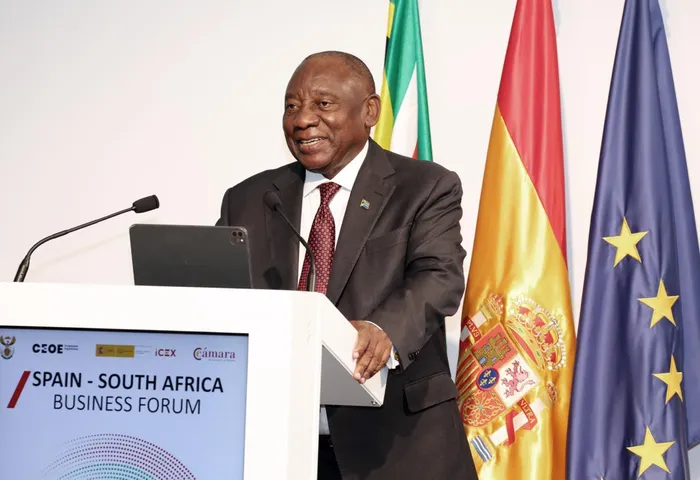
President Cyril Ramaphosa delivering a speech during the South Africa–Spain Business Forum in Madrid on Friday.
Image: GCIS
President Cyril Ramaphosa has placed trade diversification at the centre of South Africa’s economic agenda, calling for a broader and more resilient export relationship with Spain during the South Africa–Spain Business Forum in Madrid.
Spain is South Africa's fastest-growing major trading partner within the European Union.
Addressing business leaders and policymakers on Friday, Ramaphosa acknowledged the rapid growth in bilateral trade but cautioned that the structure of exports remains too narrow, exposing the relationship to risk.
While trade between the two countries reached approximately €2.8 billion (R54 billion) in 2025, with South African exports rising by 10% to €1.3bn, much of that growth has been driven by a limited set of products.
“Even though our trade relationship is strong, it remains structurally imbalanced. It is concentrated in a narrow range of products,” Ramaphosa said. “If we are to strengthen this relationship, if we are to make it sustainable, we must focus on diversification.”
Currently, motor vehicles for the transport of goods account for nearly half of South Africa’s exports to Spain, a concentration Ramaphosa warned creates vulnerability in the face of shifting global demand and supply chain disruptions.
Ramaphosa argued that diversification is not simply about expanding product lines, but about repositioning South Africa within global value chains, particularly in sectors linked to the green economy and advanced manufacturing.
Central to this strategy is leveraging South Africa’s vast reserves of platinum group metals, which are critical inputs in hydrogen fuel cells, electric vehicles and clean energy technologies.
Spain, meanwhile, is rapidly developing its hydrogen economy, presenting what Ramaphosa described as a natural alignment of capabilities.
“This creates the foundation for a new kind of partnership,” he said. “South Africa brings the resource base. Spain brings technological capability, investment and market access.”
Ramaphosa outlined a range of sectors where South Africa is seeking to expand exports to Spain and the broader European market. These include agro-processing, high-value agricultural goods, specialty chemicals, sustainable fuels, pharmaceuticals and health technologies.
He also highlighted emerging opportunities in beneficiated critical minerals, green industrial materials and electric vehicle components, areas where South Africa aims to move beyond raw material exports and into higher-value production.
A key example is the automotive sector, one of the largest on the African continent. As the global shift toward electric vehicles accelerates, Ramaphosa stressed that South Africa must avoid being relegated to a supplier of raw inputs.
“The question is not whether South Africa will be part of that value chain but whether we will be a raw material supplier or a manufacturing partner,” he said. “We want to be manufacturers and assemblers.”
Spanish investment is expected to play a crucial role in this transition. More than 150 Spanish firms already operate in South Africa, supporting over 20,000 jobs across sectors such as infrastructure, renewable energy and financial services. Companies like Acciona and Iberdrola have been involved in major energy projects, demonstrating the potential for deeper industrial cooperation.
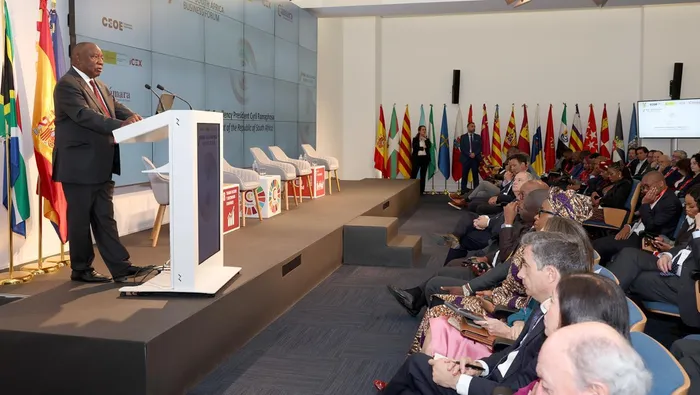
President Cyril Ramaphosa delivering a speech during the South Africa–Spain Business Forum in Madrid on Friday.
Image: GCIS
Ramaphosa said diversification must also be supported by improved domestic conditions, pointing to ongoing reforms aimed at strengthening logistics, stabilising electricity supply and enhancing the ease of doing business.
“We are making it easier to invest, easier to trade and easier to grow,” he said, adding that these reforms are essential to attracting long-term industrial partners rather than short-term investors.
At the same time, he raised concerns about global regulatory shifts that could undermine diversification efforts, particularly the European Union’s Carbon Border Adjustment Mechanism (CBAM).
While reaffirming South Africa’s commitment to climate action, Ramaphosa warned that such policies must not disproportionately impact developing economies.
“What we ask is that climate measures be accompanied by the necessary climate finance, technology transfer and transitional arrangements,” he said.
To support diversification and industrial expansion, South Africa has identified 85 investment-ready projects worth more than €62bn through its InvestSA initiative. These projects span sectors including green energy, digital infrastructure, agro-industrial value chains and pharmaceutical manufacturing.
Ramaphosa concluded by urging Spanish businesses to partner with South Africa in building more diversified, resilient and inclusive trade links.
“Our message is clear: South Africa is open for business,” he said. “We invite you to partner with us as we build industries that will serve our economies for generations.”
BUSINESS REPORT