

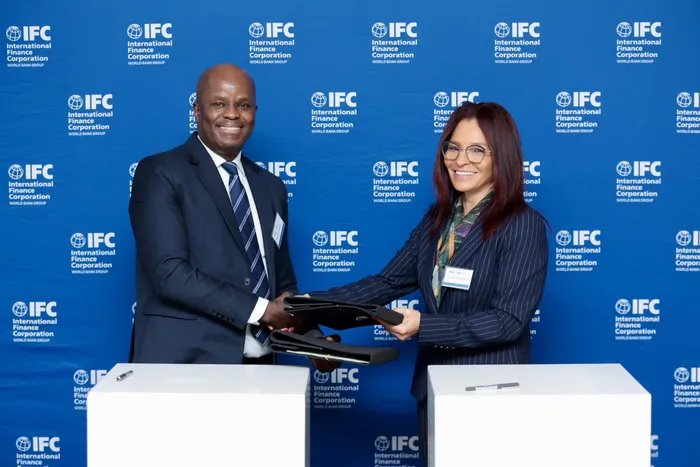
Mohale Rakgate, acting head of IFISA and Cláudia Conceição, IFC regional director for Southern Africa at the signing of the memorandum to accelerate investment in South Africa’s Water, Sanitation and Waste Infrastructure.
Image: Supplied
South Africa is stepping up efforts to tackle its deepening water crisis, with the Infrastructure Finance and Implementation Support Agency (IFISA) and the International Finance Corporation (IFC) signing a Memorandum of Cooperation aimed at unlocking investment in critical water, sanitation and waste management infrastructure.
The agreement focuses on mobilising private sector capital and expertise to accelerate the delivery of essential public infrastructure, particularly in municipalities struggling with aging systems and service delivery failures.
Water security has become a pressing economic issue in South Africa, underpinning activity across agriculture, industry and services. Research has shown that unreliable water systems can lead to significant economic losses, while investment in resilient infrastructure helps safeguard jobs, incomes and local economies.
Against this backdrop, the partnership between IFISA and IFC is designed to strengthen project preparation and improve the bankability of infrastructure projects.
By leveraging blended finance models, public-private partnerships (PPPs) and other financing mechanisms, the two institutions aim to crowd in private investment at scale.
IFISA will take the lead in project origination, coordination and implementation support within the public sector. The agency already has a strong track record in infrastructure delivery, with more than half of its work to date focused on the water sector.
“This partnership with IFC represents a significant step forward in strengthening South Africa’s infrastructure pipeline and responding to the National Development Plan goals of crowding-in private sector investments in public infrastructure,” said Mohale Rakgate, acting head of IFISA.
“By combining our efforts, we can better prepare and deliver projects that address critical service delivery needs while attracting private sector investment at scale.”
IFC, a member of the World Bank Group, will play a central role in enhancing the technical and financial readiness of projects. The institution brings global expertise in structuring complex infrastructure deals and mobilising capital in emerging markets.
As part of the collaboration, IFC is already working with IFISA, supported by the Swiss State Secretariat for Economic Affairs (SECO), on the uMkhomazi Water Project Phase 1 Raw Water Component.
The project is being implemented by the Trans-Caledon Tunnel Authority (TCTA) and is expected to play a crucial role in securing South Africa’s long-term water supply.
The partnership comes at a critical time for the country’s water sector. According to the Department of Water and Sanitation’s 2025 Green Drop Report, nearly half of municipal wastewater treatment plants are not operating optimally. This has resulted in the widespread discharge of partially treated effluent into rivers and dams, posing serious risks to public health and the environment.
Compounding the problem is the deterioration of existing infrastructure. Much of South Africa’s water and sanitation network has exceeded its design life, leading to significant inefficiencies. It is estimated that more than 40% of treated water is lost through leaks, bursts, illegal connections and metering failures, placing additional strain on already scarce resources.
Cláudia Conceição, IFC regional director for Southern Africa, emphasized the urgency of the situation and the importance of coordinated action.
“As one of the world’s most water-scarce countries, South Africa faces urgent and complex challenges,” she said.
“IFC is committed to increasing access to reliable water and sanitation services to communities by working alongside IFISA and the Government of South Africa on project preparation, institutional capacity building and identifying bankable projects that can attract the investment to meet the critical infrastructure needs.”
By combining IFISA’s local expertise with IFC’s global financing and advisory capabilities, the partnership aims to unlock a pipeline of sustainable, bankable projects. These projects are expected not only to improve service delivery but also to stimulate economic growth and enhance environmental outcomes.
BUSINESS REPORT