

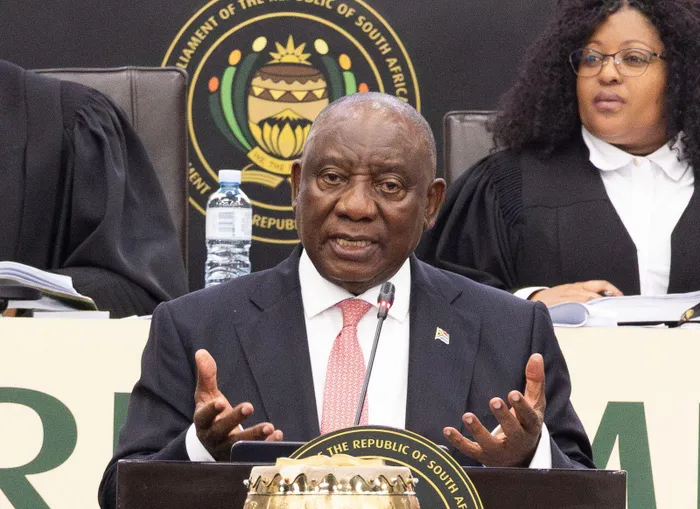
President Cyril Ramaphosa responding to oral questions in Parliament on Thursday.
Image: GCIS
President Cyril Ramaphosa has acknowledged that some of South Africa’s biggest investment commitments, particularly in renewable energy infrastructure and data centres, are not generating jobs at the scale needed to tackle the country’s deepening unemployment crisis.
Responding to oral questions in Parliament on Thursday, Ramaphosa defended the outcomes of the sixth South Africa Investment Conference, which secured R890 billion in investment commitments earlier this year.
However, he admitted that many of the country’s largest capital-intensive projects create relatively few direct jobs despite being critical for economic growth and energy security.
“Labour-intensive investments in global business services and financial services generate approximately 3,900 jobs per R1 billion invested,” Ramaphosa said.
“However, capital-intensive sectors such as renewable energy infrastructure and data centres generate between 13 and 248 jobs per R1bn investments.”
Ramaphosa’s remarks come as South Africa’s unemployment crisis worsened sharply in the first quarter of 2026, with the latest data from Statistics South Africa showing the official unemployment rate climbed to 32.7% from 31.4% in the previous quarter.
The economy shed 345,000 jobs during the quarter, reducing total employment to 16.8 million people, while the number of unemployed South Africans rose to 8.1 million. Youth unemployment climbed to 45.8%, leaving nearly 4.7 million young people without work.
Although Ramaphosa said 53 companies participating in the investment conference projected around 230,000 direct permanent jobs from their investments, he stressed that employment gains would materialise gradually over many years as projects move from pledges to implementation.
Several of the largest commitments came from companies such as Sasol, MTN Group, Vodacom and Coca-Cola Beverages Africa, with many investments linked to expanding existing operations rather than creating entirely new industries.
“These investments sustain existing jobs and incrementally grow the workforce in these companies,” Ramaphosa said.
The president acknowledged that South Africa’s unemployment crisis is rooted in structural economic weaknesses that investment attraction alone cannot solve.
“The structural unemployment problem is rooted in skills mismatches, spatial economic concentration, slow growth of the formal private sector and barriers to small business formation,” he said.
Economists warned that the latest unemployment figures highlight the widening gap between economic growth and labour absorption, particularly as sectors attracting large investment flows increasingly rely on capital rather than labour.
Marilize Putter, chief academic officer at Milpark Education, said the latest labour market data showed that even qualified South Africans are struggling to secure employment.
“This reality requires a shift in how higher education institutions prepare students for the world of work,” Putter said. “The focus cannot simply be on obtaining a qualification, but on ensuring that learning is immersive, practical and closely aligned to industry needs and workplace realities.”
She said employers increasingly demand graduates who can adapt quickly, solve problems and contribute meaningfully from the start of their careers, placing pressure on educational institutions to produce more work-ready graduates.
Meanwhile, North-West University Business School ecoomist, Prof. Raymond Parsons, warned that worsening global conditions, particularly the ongoing Middle East conflict, are beginning to place additional strain on South Africa’s economy and labour market.
“The negative unemployment figures for the first quarter of 2026 are another early warning signal of the emerging shock that the global energy crisis is beginning to have on the economy and jobs,” Parsons said.
He warned that prolonged geopolitical instability could further weaken economic growth and employment creation during the remainder of the year, adding that weak infrastructure investment and low levels of fixed investment remain major constraints on growth and job creation.
Meanwhile, Ramaphosa insisted government’s broader economic strategy — including infrastructure investment, industrial policy reforms, skills development programmes and support for small businesses — would remain central to addressing unemployment.
Government is now aiming to raise R3 trillion in new investment over the next five years as part of its broader strategy to stimulate inclusive growth and employment.
Alongside investment attraction, Ramaphosa outlined a range of public sector and military-linked youth employment and skills development programmes aimed at tackling rising unemployment.
He said government departments are implementing learnerships, internships, apprenticeships and workplace-based training initiatives supported by the Department of Public Service and Administration.
A key component of government’s intervention involves the South African National Defence Force (SANDF), which has expanded youth development and vocational training programmes.
Ramaphosa said the SANDF is supporting the National Rural Youth Service Corps programme, and the military has also established the South African National Service Institute to target young people who are not in employment, education or training.
“The programme seeks to recruit unemployed young people and equip them with a combination of classroom-based training and practical workplace experience through structured internships,” Ramaphosa said.
BUSINESS REPORT