

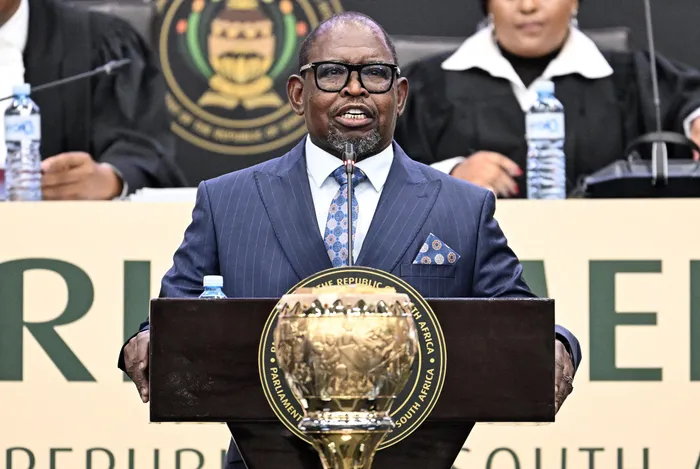
Finance Minister Enoch Godongwana said the fuel levy relief measures are designed to be revenue neutral and won't have an impact on the fiscal framework adopted by Parliament following the 2026 budget.
Image: GCIS
Trade unions have sounded the alarm over rising fuel costs, warning that government’s extended levy relief will not be enough to shield workers and the economy from a looming price shock driven by global oil market turmoil.
While National Treasury and the Department of Mineral and Petroleum Resources confirmed an extension of the temporary fuel levy reduction into June, labour groups said the intervention was too limited and risked leaving millions exposed to steep increases in petrol, diesel and paraffin prices.
According to projections by the Central Energy Fund, petrol prices could rise by more than R2 per litre, while diesel could surge by as much as R6 per litre. Paraffin, widely used by low-income households, is also expected to climb significantly, intensifying energy poverty.
Finance Minister Enoch Godongwana said the continuation of the conflict has resulted in consistent pressures on global oil prices, which has led to increases in domestic fuel prices.
However, Godongwana said for the month of June the levy of relief will be reduced to R1.50 per litre for petrol and R1.96 per litre for diesel to phase out relief before July. He said the estimated cost of temporary fuel levy relief from April to June was R17.2 billion in foregone tax revenue.
"The fuel levy relief measures are designed to be revenue neutral and will be funded through a combination of higher than expected tax revenue and underspending. It will not have an impact on the fiscal framework adopted by Parliament following the 2026 budget," he said.
The Motor Industry Staff Association (MISA) described the current measures as inadequate in the face of mounting pressures linked to the Middle East conflict, which has driven global oil prices sharply higher.
“This is not just about numbers at the pump – it is about survival. Families are being crushed between fuel, electricity, and food costs. Government’s minimal relief is a band aid on a deep wound,” said Martlé Keyter, MISA’s CEO for operations.
Keyter warned that without deeper and more sustained intervention, the expected increases in May could have devastating consequences for households already under financial strain.
MISA argued that if the initial R3 per litre levy reduction had not been extended, motorists could have faced even sharper hikes of up to R5 per litre for petrol and R9 per litre for diesel.
The union is calling for a broader package of measures, including extending and deepening fuel levy relief beyond June, introducing targeted subsidies for diesel and paraffin, and accelerating a transparent review of the fuel pricing system to ensure long-term sustainability.
Echoing these concerns, the Congress of South African Trade Unions (Cosatu) acknowledged the government’s efforts but warned that the phased withdrawal of relief could come too soon, particularly if global oil prices remain elevated.
Cosatu Parliamentary Coordinator Matthew Parks said the current intervention, while welcome, may not be sufficient to protect workers and the broader economy.
“We fear that workers, society and the economy will not cope with the planned reduction in fuel levy relief by half in June and its phasing out in July if international oil and fuel prices continue to rise,” Parks said.
He stressed that the impact of higher fuel costs extends far beyond motorists, affecting public transport, food prices and overall inflation. For many workers, transport alone already consumes a large share of income, leaving little room to absorb further increases.
“Workers already drowning in debt, supporting up to seven relatives each and spending an average of 40% of their meagre wages on transport, will not be able to continue to survive such painful petrol, diesel and paraffin price hikes,” Parks added.
Cosatu also raised concerns about the lack of targeted relief for paraffin users, noting that millions of poorer households rely on the fuel for basic energy needs.
Beyond maintaining the levy relief, the federation has called for a wider set of interventions, including making public transport more affordable, adjusting social grants for inflation, and implementing measures to contain rising food and electricity costs.
Parks further urged the South African Reserve Bank to avoid increasing interest rates in response to inflation driven by external factors, arguing that higher borrowing costs would only deepen the financial strain on households.
BUSINESS REPORT